
Digital
Sovereignty
Europe’s future depends on how technology
can be understood,
controlled, and shaped.
Digital sovereignty is a key question — and we analyze its prerequisites, limitations, and consequences.

Digital Dependency:
Why Europe Is Increasingly Losing Control Over Its Digital Infrastructure
Legal Dependency
- US laws such as the CLOUD Act and FISA 702 enable access — including to data held within the EU.
- Companies are unable to fully meet their GDPR obligations.
- Auditability and oversight of major cloud platforms are in practice not possible.
Technical Dependency
- Around 65% of global cloud infrastructure lies with AWS, Azure, and Google.
- Identity, communication, and AI are predominantly based on non-European platforms.
- Europe has no control over central core digital systems.
Strategic Dependency
- Vendor lock-in increases year on year — exiting becomes progressively more costly.
- European data flows into US training models for AI.
- Europe is losing innovative capacity and strategic room to maneuver.
Day-to-Day Life in European Offices
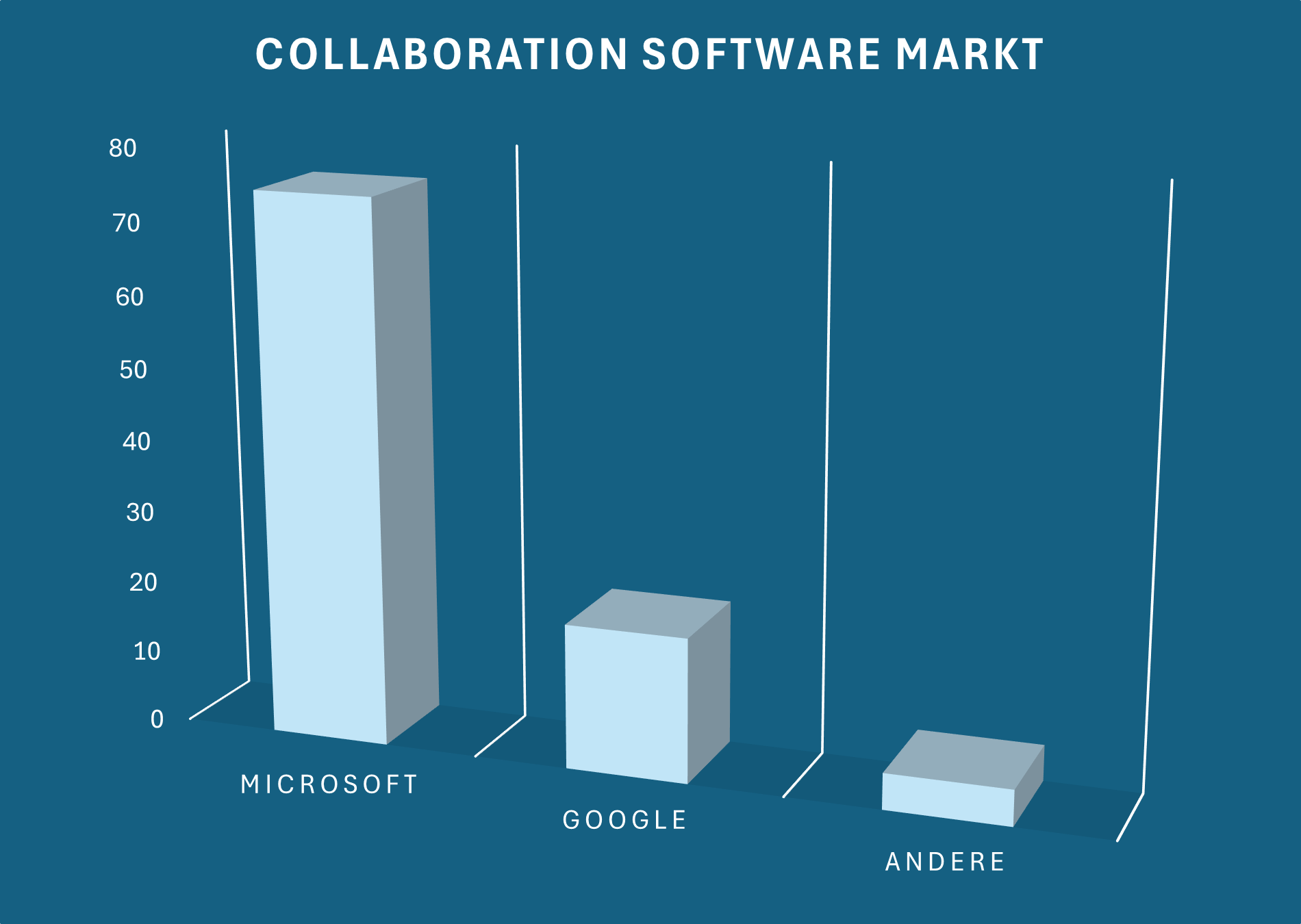
The market for collaboration software is dominated by only two vendors.
A warning signal for business, politics — and our society as a whole.
Why is it Problematic?
1️⃣ Loss of Competitiveness
Europe builds its companies on platforms it does not control. This means others decide:
- who has access to data
- which functions are available
- which business models remain possible
- which are no longer possible
Innovation depends on the goodwill of a handful of tech corporations.
2️⃣ Security and Resilience Risks
Our public administrations, schools, companies, and critical infrastructure run on systems that can — overnight:
- be shut down,
- be restricted,
- become more expensive,
- or be politically influenced.
A technical or geopolitical problem immediately becomes a societal problem.
3️⃣ Democracy Risks & Loss of Control
When data, communication, and AI are created and processed outside Europe’s sphere of influence:
- we lose transparency
- we lose control
- we lose the ability to enforce the law
- It is based on different values
Training data does not come from Europe — yet it shapes European societies and markets.
4️⃣ Strategic Vulnerability
Dependency limits the capacity to act. Without its own infrastructure, Europe can neither:
- set technological standards
- secure basic digital provision
- nor make sovereign political decisions
Sovereignty ends where dependency begins.
The Challenge Becomes an Opportunity
The solution is achievable — and it gives Europe new strength, innovative capacity, and resilience.
1️⃣ Own Digital Infrastructure
Digital sovereignty requires infrastructure that is subject to European law, European oversight, and European security standards.
- European cloud, communication, and collaboration platforms
- Open and auditable technologies
- Infrastructure that is not subject to foreign legal systems
Digital infrastructure today is as fundamental as energy, transport, or communications networks and must be treated strategically accordingly.
2️⃣ Open Standards & Interoperability
Dependency arises where switching has in practice become impossible. That is why we need:
- Open protocols and standards (e.g. IMAP, CalDAV, CardDAV, WebDAV, OIDC)
- Reliable data portability
- Verifiable interoperability between providers
- Competition based on open interfaces
Open standards alone, however, are not sufficient. What is decisive is that systems are interoperable in practice and that switching providers remains possible without loss of data or functionality.
3️⃣Resilient AI and Data Spaces
The development of AI is increasingly determined by the availability of data, computing power, and platforms. Europe therefore needs its own:
- Data spaces for business, science, and public administration
- High-quality and trustworthy training data
- Transparent and traceable AI models
- Secure European AI and computing infrastructures
Those who control data, computing power, and AI shape the economic and social development of the future.
4️⃣ Digital Independence
Digital sovereignty does not emerge through individual products, but through strategic capacity to act. This includes:
- Control over data, identities, and digital processes
- Use of open standards and interoperable systems
- Building own competencies and expertise
- Reduction of critical dependencies and development of viable alternatives
Digital independence does not mean isolation. It means the ability to decide autonomously which technologies are used and under what conditions this takes place.
Our Work on This Topic
Policy Briefs
Policy Briefs are aimed at decision-makers in politics, public administration, and business. They summarize complex issues concisely and derive concrete options for action from them.
Analyses
Analyses provide systematic, fact-based contextualization of current developments, legal frameworks, or technological changes.
Commentaries
Commentaries reflect a reasoned assessment or position of the Institute on current events, political decisions, or societal debates.
They are grounded in analyses and facts, but are deliberately normative and discourse-oriented. Commentaries are intended to take a stance, sharpen debates, and stimulate thinking.