
Future of Society
& Democracy
Democracy Is the Infrastructure of Freedom — Without effective democracy, we lose the ability to resolve conflicts, control power,
and shape the future.
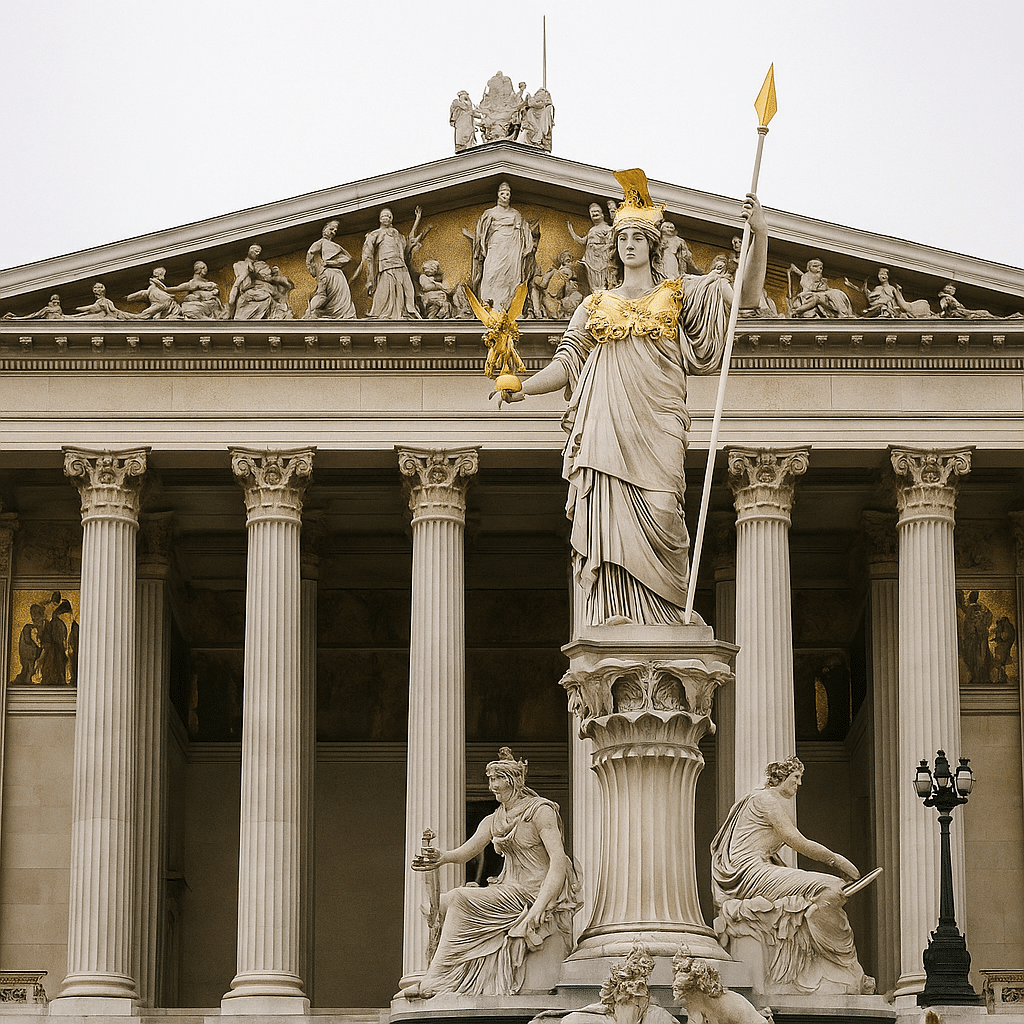
Democracy thrives on the ability to make decisions, tolerate differences, and keep power in check.
Today we are experiencing something different:
- Polarization and mistrust are crowding out the capacity for compromise.
- Processes become veto systems — decisions remain unresolved.
- Public rhetoric replaces implementation — impact fails to materialize.
The system is increasingly losing its effectiveness. But it can be rethought and restored to what it was designed to be.
The Future of Democracy
A democracy that empowers through education, enables genuine co-creation, builds on knowledge — and earns trust through transparency. This model emerged from a participation project at the Upper Austrian State Parliament.
🎓 Education
Accessible. Digital. Empowering.
- Political processes are explained in an understandable way.
- Digital literacy strengthens media competence.
- Democracy is made tangible as a lived practice.
- Independent media inform on the basis of facts.
🤝 Co-Creation
Genuine participation for all members of our society
- Digital tools enable ongoing involvement.
- Petitions, citizens’ assemblies & platforms foster co-creation.
- Even people without voting rights are given a voice.
🔬 Solutions
Facts over ideology.
- Decisions are based on data & expertise.
- Complex topics are presented in an accessible way.
- Policy is guided by evidence, not populism.
🧭 Transparency
Trust through openness.
- Political processes are traceable and comprehensible.
- Corruption is combated, decisions are explained.
- Financial flows & power structures are openly documented.
Photo: Austrian Parliament
Johannes Zinner
Dieses Verständnis von Demokratie steht heute unter erheblichem strukturellem Druck.
Democracy Under Structural Pressure
Democracy is the central infrastructure of modern societies. It enables peaceful conflict resolution, the control of power, and collective shaping of the future. Current empirical findings, however, show clearly: the core functional conditions of democratic systems are coming under increasing structural pressure.
Loss of Trust
- Only 43% of people believe that the political system functions well (Foresight).
- Around 50% of Austrians do not trust the federal government (EU Commission).
- Authoritarian attitudes are on the rise — in particular the desire for executive leadership beyond parliamentary negotiation.
Distorted Public Opinion Formation
- Digital platforms are undermining viable business models for independent media.
- Government advertising allocation reinforces political dependencies (Court of Audit, 2020).
- Algorithmic amplification of individual actors distorts public discourse (QUT study on X, 11/2024).
- Inadequate literacy: 30% of people in Austria cannot read with adequate comprehension.
Declining Political Participation
- 1.4 million people in Austria are excluded from the right to vote.
- 23% non-voters in the last parliamentary election.
- In Vienna, only around 40% of the total population was actually able to participate in elections.
- People feel that they cannot make a difference anyway.
Solution-Orientation Under Pressure
Political decisions increasingly follow partisan logic rather than evidence.
- Science is selectively accepted depending on political affiliation (OECD, Pew).
- Polarization crowds out the capacity for compromise and objective weighing of issues (Iyengar, Mason).
- Strong party discipline (“Klubzwang”) weakens open deliberation (Bailer; Strøm).
- Algorithmic amplification distorts public debate (Vosoughi et al.; QUT 2024).
Democracy is increasingly functioning formally correctly, but is factually constrained: processes block, responsibility diffuses, impact fails to materialize.
Democracy is not being abolished — it is being hollowed out. The greatest danger is not a formal rupture, but an illiberal democracy: elections take place, parliaments continue to exist — yet decisions elude public oversight, participation loses its effect, power concentrates.
A Better Democracy
Democratic systems cannot be “repaired.” But their capacity to shape the future can be deliberately strengthened — or further weakened. Democracy is the space where we determine how we want to live together:
🎓 Knowledge
Democracy presupposes functioning, critical, and independent media. They are the fourth pillar of democracy.
Democratic participation presupposes understanding. Without political, media, and digital literacy, participation becomes a mere formality.
🤝 Co-Creation
A vibrant democracy requires opportunities for participation in all walks of life.
People want to be heard. Democratic solutions do not require maximum approval, but broad societal acceptance.
Solutions
When decisions are no longer made on the basis of evidence but follow partisan logic, institutions lose their capacity to govern effectively.
Science thrives on doubt. Critique and questioning are not a disruption, but an obligation — provided they are evidence-based. Where science no longer self-corrects, it loses its role as the foundation of rational policy. (Sapere aude.)
🧭 Transparency
Without the ability to trace power, financial flows, and decisions, mistrust arises — regardless of outcomes.
We know what makes a democracy vibrant and effective. Systemically, we are currently far from this — not for lack of knowledge, but for lack of implementation. This is precisely where our work begins.
The Contribution of the 4future.institute
The Institute does not defend positions. It defends the conditions under which reasonable decisions remain possible.
1. Making Complexity Understandable
Democratic decisions often fail not for lack of will, but for lack of understanding. The Institute translates complex interdependencies from technology, business, and society into structured, comprehensible analyses — beyond slogans and partisan logic.
2. Strengthening Evidence-Based Debate
We promote a political culture in which data, expertise, and verifiable arguments carry weight once again. Not as technocratic truth — but as a shared basis for working together.
3. Spaces for Reflective Engagement
Democracy needs places where doubt is permitted. Where critique can be expressed on the basis of evidence — and changing one’s mind is not a loss of face. Sapere aude is not a quotation, but a lived practice.
4. Restoring the Capacity to Shape the Future
We analyze why processes block, responsibility diffuses, and impact fails to materialize — and develop models for how democracy can once again become capable of making decisions and learning, without abandoning its core values.
Democracy does not fail from too little engagement, but from too little orientation. This is precisely where the 4future Institute begins.
Our Work on this Topic
Policy Briefs
Policy Briefs are aimed at decision-makers in politics, public administration, and business. They summarize complex issues concisely and derive concrete options for action from them.
Analyses
Analyses provide systematic, fact-based contextualization of current developments, legal frameworks, or technological changes.
Kommentare
Commentaries reflect a reasoned assessment or position of the Institute on current events, political decisions, or societal debates.
They are grounded in analyses and facts, but are deliberately normative and discourse-oriented. Commentaries are intended to take a stance, sharpen debates, and stimulate thinking.