
Why open standards alone are not enough.
Key findings
- Missing interoperability is a real switching barrier — not a technical detail.
- Open standards alone do not produce digital sovereignty.
- Microsoft does not fully comply with the ISO standard they themselves lobbied to establish.
- Europe regulates app stores — but not the office software on which its economy runs.
Context
Formal standardisation and practical interoperability are two different things. Europe has conflated the two — with structural consequences for competition, switchability, and digital sovereignty.
Legal ⚖️ The Digital Markets Act regulates gatekeepers. Microsoft Office meets every quantitative DMA threshold — and was nonetheless not designated as a gatekeeper.
Technical 🔧 CalDAV, CardDAV and IMAP have been open standards for decades. Microsoft Outlook still does not support them fully natively.
Economic 📊 Whoever wants to switch vendors carries the reputational risk when documents render incorrectly at a client’s site — not the platform provider.
Consequences
- Switching costs remain artificially high.
- European vendors fail not because of quality — but because of structural interoperability disadvantages.
- Dominant platforms entrench themselves not through innovation — but through lock-in.
- AI accelerates these dependencies at the semantic level.
The Solution: Verifiable Interoperability
- European Interoperability Certification — three levels
- Austrian Standards International as national certification body
- Public Procurement as a strategic lever
- DMA Extension to cover digital work platforms
Further Reading
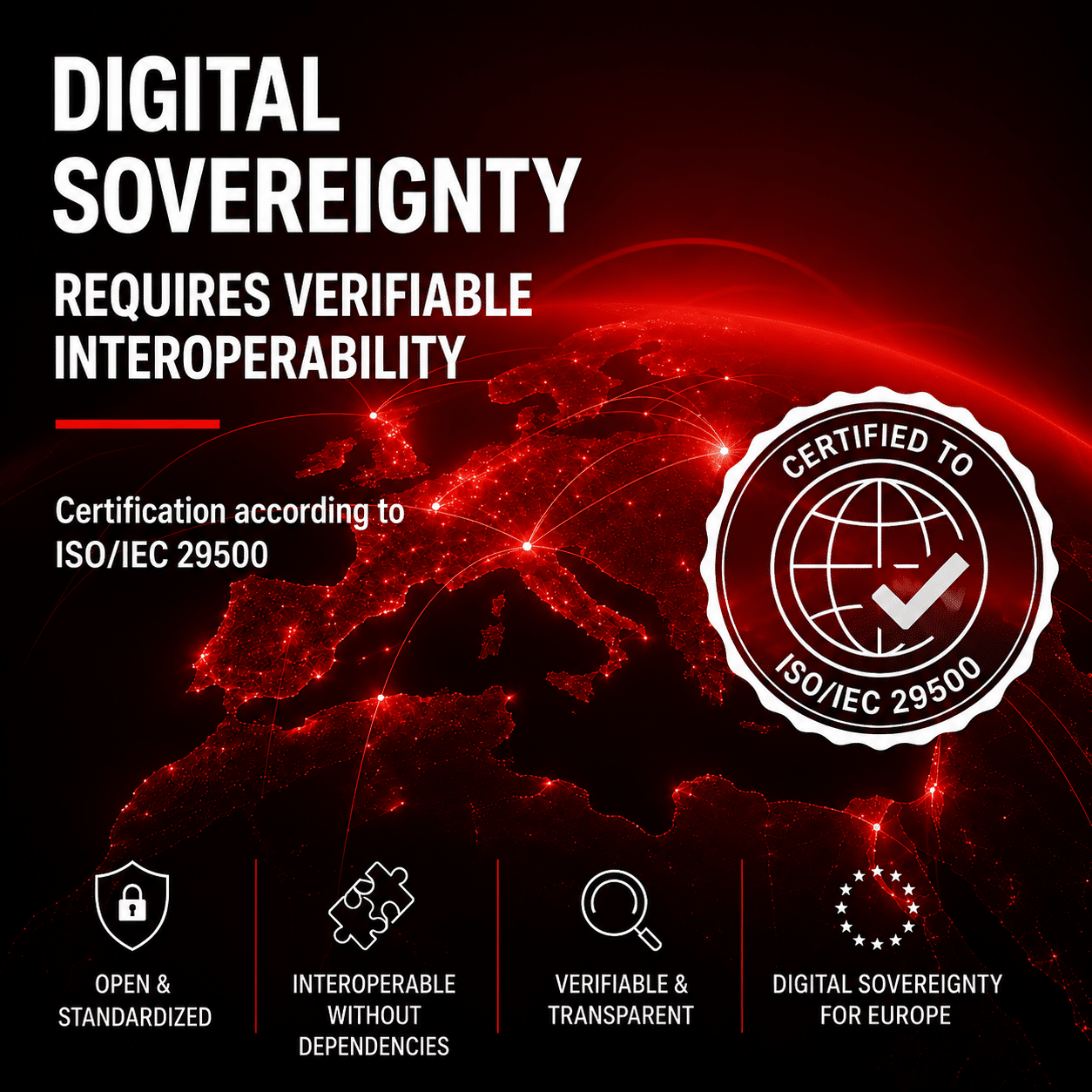
Digital Sovereignty Requires Verifiable Interoperability
The 4future.institute analyses the structural conditions under which Europe can remain capable of acting — politically, economically, and as a society. This paper deepens the interoperability dimension of the policy brief “Digital Sovereignty in Europe“ (2025/26) — one of the central and so far underestimated preconditions for digital sovereignty.
Europe has open standards and norms for digital collaboration. But open standards alone do not produce digital sovereignty. That is the problem this paper describes — and addresses.
The Structural Problem
De facto standards are set by market power, not by norms
Microsoft Office holds approximately 80% market share in the enterprise segment. Established open standards exist for calendar and address book access. Microsoft does not support them — as a result, Outlook can only be used with third-party servers with considerable difficulty, if at all.
At 80% market share, the implementation practices of the dominant vendor become the de facto standard — regardless of intent or norm.
ISO norms do not protect against incompatibility
OOXML, the document format used by Microsoft Office, has been an ISO standard since 2008 (ISO/IEC 29500) . Microsoft does not fully comply with this norm itself — despite having lobbied hard to establish it. As a result, it is barely possible for other office software vendors to read or edit Microsoft documents without errors. Not even Microsoft itself renders complex documents consistently across its desktop, web, and mobile versions.
The actual reference standard is a single software configuration — not a norm. Formal openness does not automatically produce practical interoperability.
The Challenge for Users
Many organisations would gladly switch to alternative solutions for digital collaboration. In practice, everyday documents — presentations containing tables, documents with tables of contents — frequently do not work reliably enough across platforms to make switching a risk-free proposition.
When a presentation renders incorrectly at a client’s site, the reputational risk falls not on the platform vendor — but on the organisation that chose to switch.
→ The absence of practical interoperability becomes a real switching barrier.
The Regulatory Gap
The Digital Markets Act does not reach here
The DMA regulates so-called gatekeepers. Microsoft Office meets every quantitative DMA threshold — and was nonetheless not designated as a gatekeeper. The actual platform lock-in does not arise from absent standards, but from the substantial technical and organisational costs of switching in practice.
Europe regulates app stores. But not the office software on which large parts of its economy run.
What Europe Needs Now
Verifiable interoperability — not formal standardisation. A system of four interconnected measures:
1. European Interoperability Certification
Three levels: standard support — full interoperability — lossless migration. What is regulated is not the vendor, but a verifiable property of the product.
2. National Pilot Framework
Austrian Standards International as a model for a national pilot that can be scaled to the European level.
3. Binding Procurement Requirements
Public bodies procure only certified systems. Public procurement becomes a strategic lever for change.
4. DMA Extension
Interoperability obligations for digital work platforms — closing the regulatory gap the DMA currently leaves open.

Werner Illsinger is a business psychologist (MBA), management consultant, and technology expert (HTL engineer). After more than 18 years in leadership positions at Microsoft and senior roles in the IT industry, he founded the 4future.group to actively shape the transformation of business and society in the digital age. At the University of Applied Sciences Carinthia, he teaches Business Processes, Digitalization, Leadership, and Organizational Development.