
Why open standards alone are not enough. Policy Brief No. 2026-002 (EN), Version 2, 11/2026
Key findings
- A lack of interoperability is a real barrier to switching, not a technical detail.
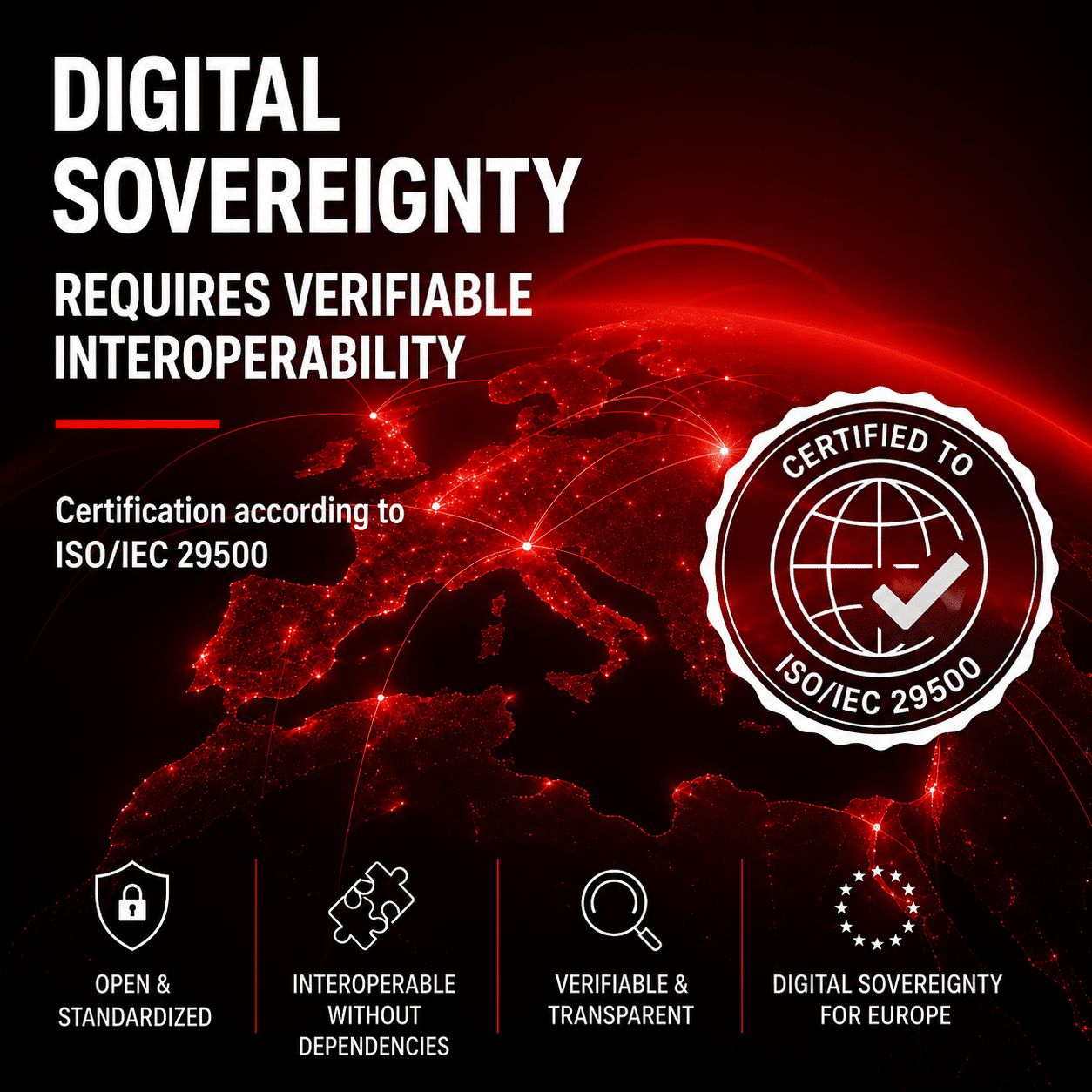
- Open standards alone do not create digital sovereignty. What matters is whether their implementation can be verified.
- To this day, Microsoft Office saves by default in the transitional format of the ISO standard, which was never intended for new documents. Exchanging documents reliably with Word takes more than the standard.
- Europe mandates common chargers and interoperable messengers, but not the interchangeability of the office software on which its economy runs.
Context
Formal standardisation and practical interoperability are two different things. So far, European digital policy has relied mainly on the former and has not tested the latter. This has structural consequences for competition, switchability and digital sovereignty.
Legal ⚖️
The Digital Markets Act covers Microsoft as a gatekeeper for Windows and LinkedIn, but not for Teams and Office. The 2025 Teams commitments and the Data Act help only in part: whether switching actually works in practice is not yet verified by anyone through open tests.
Technical 🔧
CalDAV and CardDAV have been open standards for almost two decades. Microsoft Outlook still does not support them natively, and in the new Outlook, IMAP accounts are functionally restricted.
Economic 📊
If a document is rendered incorrectly for a client, the reputational risk is borne by whoever switched providers, not by the platform provider.
Consequences
- Switching costs remain high and grow with every integration.
- European providers often fail not because of quality, but because of structural interoperability disadvantages.
- Dominant platforms are stabilised not only by product quality, but also by lock-in.
- AI is shifting this dependency to the semantic level.
The Solution: Verifiable Interoperability
- A European interoperability certification based on a public test corpus, with three levels: verified baseline profile, verified interoperability, verified switchability
- Public procurement as a strategic lever, anchored in the new EU procurement regulation
- Linkage to the assurance levels of the proposed Cloud and AI Development Act
- A standardisation request to CEN, CENELEC and ETSI, and at national level a pilot programme, for example with Austrian Standards International
- Examining an extension of the DMA to office and collaboration platforms
Further Reading

Werner Illsinger is a business psychologist (MBA), management consultant, and technology expert (HTL engineer). After more than 18 years in leadership positions at Microsoft and senior roles in the IT industry, he founded the 4future.group to actively shape the transformation of business and society in the digital age. At the University of Applied Sciences Carinthia, he teaches Business Processes, Digitalization, Leadership, and Organizational Development.