
A personal contribution by Werner Illsinger, 4future.digital
Take a look at this graphic. You’re in the center. All around you: American corporations that know where you are, what you buy, who you talk to, how healthy you are — and who you vote for. This isn’t science fiction. This is today. This is your digital life. And right in the middle of it all: your email.
You are the product.
Gmail is free. In 2025, Google earns over 250 billion dollars a year. How?
With you. With your emails. With your calendar. With your contacts. With your tasks. With everything you do digitally.
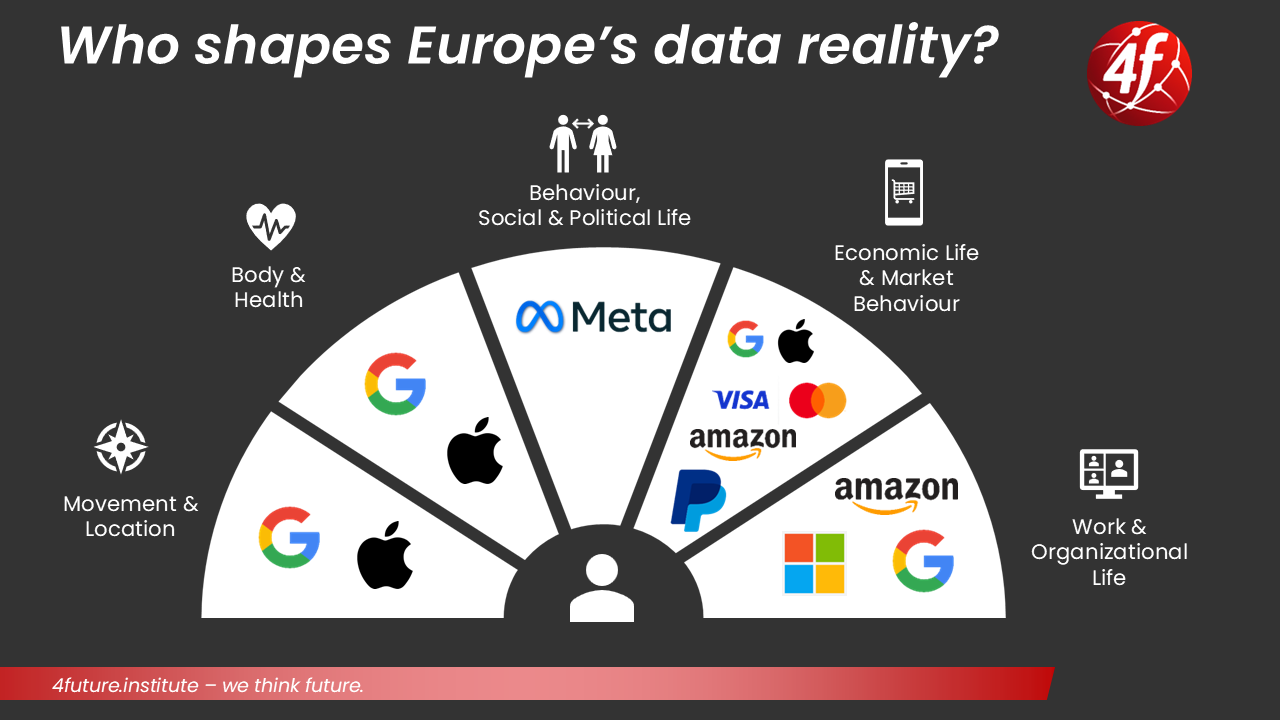
Slide from my presentation “I am afraid Dave, I cannot do that” at the Austrian Academy of Sciences (ÖAW) in April 2026
If a product is free — you are the product.
This is not a moral judgment. It’s a business model. And it works — because most people don’t see it. Or don’t want to see it. Or don’t have an alternative.
The transparent citizen is no longer a metaphor.
At the Austrian Academy of Sciences, we talked about this. About data sovereignty. About digital self-determination. About the transparent citizen.
What stands out: most people nod. They know it. But they do nothing — because they believe there is no alternative.
There is one. But more on that later. First, the full extent of the problem.
It’s not just about you. It’s about Europe.
Take another look at the graphic.
Every European company using Microsoft 365 pays a monthly fee to an American corporation. The data flows into American data centers. The value creation flows away. The dependency grows.
This is no small matter. This is structural weakness.
And it becomes dangerous when geopolitical interests come into play.
When America pulls the plug.
April 2022. Amsterdam Trade Bank. A Dutch bank. Financially solvent. €1.2 billion in assets.
Following US sanctions against Russian owners, Microsoft immediately blocked all email access. Amazon terminated all cloud services. Within 48 hours, the bank was operationally paralyzed.
On April 22, 2022, the court declared the bank insolvent.
Not because of bad business. Not because of insolvency. But because Microsoft had pulled the plug.
A Dutch court had to threaten Microsoft with fines of up to €100 million — just so the insolvency administrators could gain access to their own data.
And then there was the International Criminal Court.
February 2025. The Hague. The International Criminal Court — founded in 2002, recognized by 124 states, built on Microsoft Azure.
The Trump administration imposed sanctions on the ICC’s chief prosecutor. As a result, he lost access to his Microsoft email account. The ICC had to fall back on Proton Mail. Emergency sessions. Securing evidence. Out of fear.
The ICC’s IT manager subsequently wrote internally:
“We must reduce dependencies and strengthen the technological autonomy of the Court — even if that is costly, inefficient, and uncomfortable in the short term.”
In October 2025, the ICC switched from Microsoft 365 to openDesk — a European open-source alternative.
Microsoft confirmed it under oath.
June 2025. French Senate. Under oath.
Anton Carniaux, Legal Counsel of Microsoft France, was asked directly:
“Can you guarantee that data of French citizens will never be shared with US authorities without the consent of French authorities?”
His answer:
“Non, je ne peux pas le garantir.”
No. I cannot guarantee that.
This applies not only to France. It applies to every EU member state. It applies to Austria. It applies to you.
The CLOUD Act obliges American companies to share data with US authorities — regardless of where the data is physically stored. Servers in Vienna change nothing about this as long as the company is American.
Why we built 4future.email.
Since 1986, we have been operating digital infrastructure in Austria. Not because it was always profitable. But because we believe that digital tools belong in the hands of people — not in the hands of a few large corporations.
This is not a slogan. It is the reason we exist.
When we observed the developments of recent years — the CLOUD Act, the sanctions against the ICC, Microsoft under oath — it became clear to us: it is no longer enough to talk about it. We have to build the infrastructure.
So we did.
What we built.
4future.email is not just another email provider. It is a building block for digital sovereignty.
What’s behind 4future.email:
A cluster of 12 servers in Vienna. Our own data center — not rented, not at a hyperscaler. Carrier-grade infrastructure — the same quality used by major telecommunications providers. Real-time DMARC monitoring — we see immediately when someone sends emails in your name.
What you get:
50 GB mailbox. Calendar. Contacts. Tasks. On all devices. In sync. Reliably. Just like Exchange Online — but Austrian. Without the CLOUD Act. Without anyone reading along.
What it costs:
€3.90 per month. Less than Microsoft Exchange.
For private individuals. For businesses. For Europe.
You might think: I have nothing to hide.
That’s not the point.
The point is self-determination. The point is that you decide who sees your communications. Not an American corporation. Not a US authority. You.
And if you run a business — a law firm, a medical practice, an association, an SME — it’s no longer a philosophical question. It’s a legal one. GDPR. Professional confidentiality obligations. Compliance.
Microsoft confirmed it under oath: they cannot guarantee it.
We can. Because we are Austrian. Because we operate our own infrastructure. Because we have been doing exactly that since 1986.
What you can do today.
Don’t wait for politics. Don’t wait for European regulation. Don’t wait until it’s too late.
Every single step counts. Every mailbox that switches from Gmail or Microsoft to a European provider is a small step toward digital sovereignty.
When thousands take this step — something changes.
4future.email — Get started now
Your mailbox is ready in 10 minutes. €3.90/month. Austrian infrastructure. No CLOUD Act.
Or come to one of our events. We’re happy to explain it to you in person.
4future.digital — backbone of your digital future. We have been operating digital infrastructure since 1986. From Vienna. For people.
This article also appears on 4future.institute — our think tank for digital future issues, which has also published a policy brief on the topic of digital sovereignty.
Feel free to share.
Because digital sovereignty is not created by a resolution in Brussels. It is created by thousands of individual decisions. Today.

Werner Illsinger is a business psychologist (MBA), management consultant, and technology expert (HTL engineer). After more than 18 years in leadership positions at Microsoft and senior roles in the IT industry, he founded the 4future.group to actively shape the transformation of business and society in the digital age. At the University of Applied Sciences Carinthia, he teaches Business Processes, Digitalization, Leadership, and Organizational Development.